|
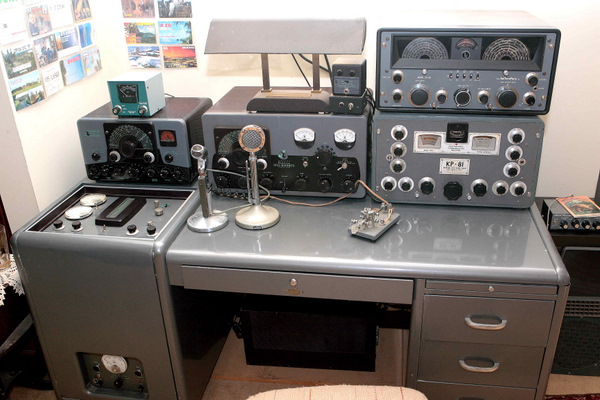
Above photo (left to right) is the G.4/226 power supply/VOX system, G.4/225 phasing type SSB/DSB/CW transmitter, G.4/215 receiver, and G-222 TR AM/CW transmitter. It is fairly low power so hopefully conditions are good, the SSB transmitter uses a pair of 6146 tubes and is rated at 150 watts input. I will be on one morning next week with the G-222 TR on 3885 AM. It is also fairly low power and uses a single 6146 modulated by a pair of 807 tubes (those Italians obviously liked a lot of audio). |
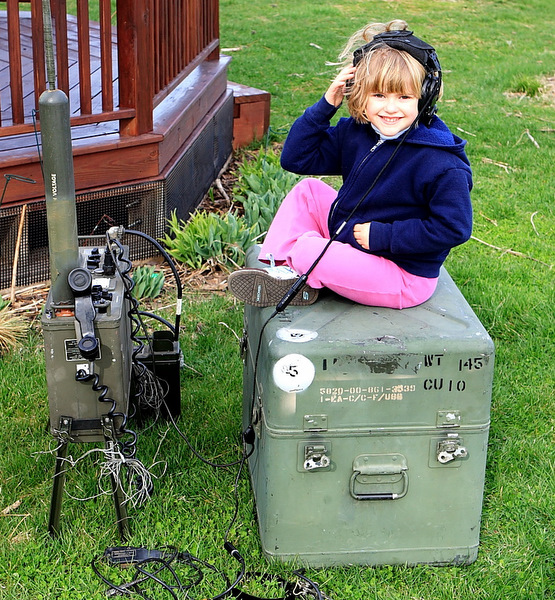
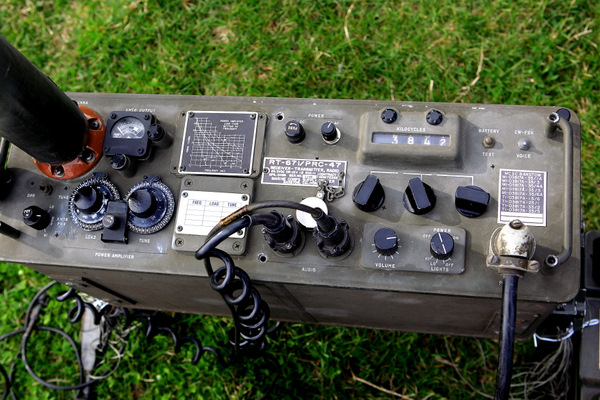
Below photos of my PRC-47 with daughter Anna as "guest" operator sitting on its transit case.
I picked up the PRC-47 a couple of years ago at the Peoria hamfest, it was packed in the transit case with all accessories including the whip and wire antennas, leg and counterpoise set, pack frame, telephone style handset, headphones, "knee" key, battery case, and all power cables. It was being powered by a 24 volt switching power supply which is at the low end of its acceptable voltage range with 26-28 volts preferred; that may have been the reason for the distortion. I changed the sideband filter so it will operate LSB and added a variable tuning modification to tune in between the 1 Khz. steps.
According to what I have learned, the PRC-47 was meant to be a "man pack" radio mainly used by forward air controllers. The main transceiver weighs 65 pounds with pack frame and an assistant carried the 3 batteries and other accessories which were another 65 to 70 pounds.
73, Rodger WQ9E |
|
 |
 |
|
|
|
The Trio TX-310 uses a single Japanese S-2001 final and this tube appears to fit
somewhere between a 2E26 and the original 6146 in power capability; a 6146 seems
to make a fine replacement for it. I have a Hy Gain 3750 (actually sourced from
Matsushita/Panasonic)that uses the A variant of the S-2001 which I believe is
the same as our 6146.
The Trio only supplies 420 volts under load to the final and the full scale
reading for plate current is 150 mils so it wasn't meant to be a power house.
Surprisingly the transformer is very large for such a low power rig and is about
the same size as a Heathkit HP-23 series. Like the Heath SB/HW series it is
full of rubber belt drives and there are 3 for the driver tuning and a fourth is
used for the loading control. It has an odd power supply with a 150 volt
regulated output from one winding and then the other winding is used in a
voltage doubler configuration supplying 425 volts "HV" and a lower B+ for most
of the remaining circuits. It does cover 80 through 6 meters and is all mode
with a nice built in VOX system and a tune mode which allows peaking the driver
tune on the ALC meter without producing RF output. Control is either via
external VFO or internal crystal oscillator and the spotting control is
activated by pulling out the mic gain control and provides the Drake style zero
beating birdies.
The matching receiver works quite well and covers JJY/WWV in addition to 80 thru
6 meters. It is dual conversion with a choice of wide or narrow filtering in
the 455 Khz. 2'nd IF. It is odd in that in addition to the normal preselector
"peaking" there is a concentric control for peaking the variable first IF. So
both controls must be adjusted as you tune across the band. The VFO is
typically Kenwood light with a very nice tuning feel.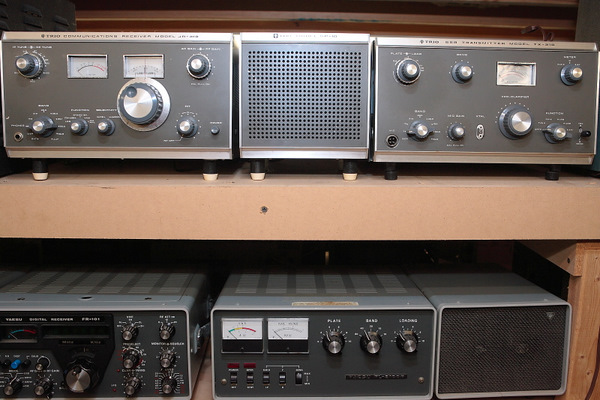
|
Allied receiver/transceiver
The Allied A-2516 receiver is somewhat similar to the Trio JR-310 and it was
actually the Allied receiver I was looking for when I came across the Trio at
the Peoria IL hamfest a couple of years ago. The Trio and speaker were marked
$50 and I picked them up. As I was carrying them to the truck I passed another
seller unpacking the Allied A-2516 receiver and A-2517 transceiver with its
power supply/speaker so I ended up also finding the ones for which I had been
searching. When I was studying for my Novice ticket in 1974 I came across one
of the older Allied catalogs that featured their A series Trio imports. Now I
just need to find the matching VFO to go with the transceiver and I will have
the complete Allied setup. I attached a photo of my Allied gear.
I had helped a JA ham out with some information and he asked me if there was any
Japanese gear I was looking for so I mentioned the TX-310. A month later he
found one on the JA Yahoo auction site and offered to bid for me. The auction
price for the transmitter was under $100 but it was $120 to ship it here. It
would have been cheaper to go with surface shipping but I decided given the
relative rarity that it was worth paying a bit more to improve the odds of
getting it in good shape. I know that you also purchased some of the Chinese
receivers from the ebay seller so you are also very familiar with the speed of
surface shipment.
When the TX-310 arrived it worked but it had a mod to increase the carrier
output on AM. Since I have plenty of high level AM rigs and the mod wasn't that
neatly installed (nor was it documented) I removed it and returned the rig to
stock.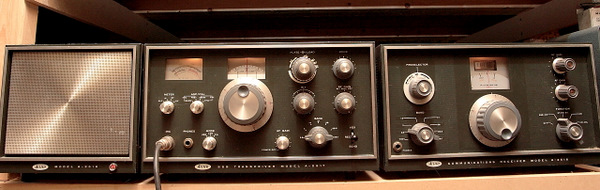
|
|
The transmitter is a 600T rated for 600 watts SSB and 500 CW on 80-10 meters using a pair of 6KD6 finals. It is de-rated to 150 watts AM and 100 watts for RTTY. The receiver is a 600R "custom" which has the added noise blanker and AF filter in addition to a 16 pole SSB filter along with 8 pole CW and AM filters. The twins required cleaning, replacement of the high/low power switch on the transmitter, and repair to the transmitter carrier oscillator circuit along with a complete realignment. The twins do work pretty well, sound good on receive, and produce a lot of power but pale in comparison to the construction and performance of the various incarnations of the Drake 4 line.
In typical Swan fashion they have a few oddities. The VFO uses twin tuning capacitors in parallel. The regular VFO knob tunes a 200 Khz. segment around the frequency chosen by the coarse tuning knob. When the coarse knob is set to 0 the 200 Khz. range is centered on the classic SSB segment but the coarse knob can be reset to plus/minus 500 Khz. to cover the entire band plus additional frequencies around the 80-10 meter range. On 10 meters the main control tunes a 500 Khz. segment. Swan notes that the calibration of the 200 Khz. control will suffer in accuracy as the coarse knob is moved further to either side of zero. The receiver uses audio derived
AGC. |
|
|

|
|
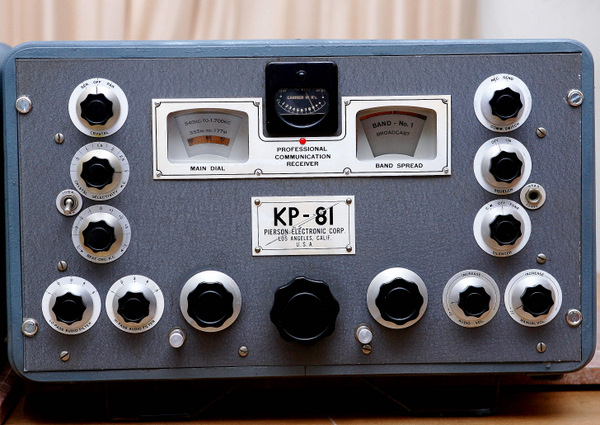
The KP-81 is pretty rare and I was lucky to find mine. I got it at the Peoria hamfest about 4 or 5 years ago. There was an older ham struggling to get a Johnson transmitter out of his pickup and while helping him I spotted a KP-81. When I asked him how much his response was you have to buy all of them. So I ended up with a stock Pierson KP-81, a second unit modified with miniature tubes in the front end, and a third parts unit along with two complete power supply/speaker units.
The KP-81 is the only "non-National" receiver I am aware of that uses a sliding coil catacomb for band switching. The Pierson unit is much larger than that used by National. The receiver proper weighs around 70 pounds and the matching speaker weighs another 45-50 pounds. The speaker console contains the power supply and push/pull audio output stage. The frequency is pretty easy to read as long as you are viewing it straight on. The dial markers are projected by a lamp and lens assembly from behind the dial. Tuning is very smooth and the variable capacitors have ball bearing assemblies at both ends, there is an additional bearing assembly where the tuning shaft goes through the front panel. A moderate spin of either tuning knob will send it to the end of the range. Turning the bandspread cap just beyond the marked set point grounds the antenna input and turns on the calibrator. It is a single conversion design with the IF spread across two plug in chassis on either side of the receiver. The RF section has two RF amplifiers and sits in the middle of the receiver. The crystal filter can be used in either series or parallel (notch) mode and it has a selectable bandpass audio filter in addition to adjustable high and low pass audio filters. There are separate noise limiters for AM and CW and a squelch system that works very well on AM.
The IF sections are very easy to work on; all you do is loosen 4 bolts and they unplug. But the RF section was a major pain to recap. You have to remove the sliding coil catacomb, unsolder around 40 leads from the tuning capacitors, unbolt the coil contact strip and finally the section can be removed. Then the real fun begins since Karl Pierson designed it to keep the RF leads as short as possible. The front end compartment consists of two interlocking U shaped shells with tube sockets and terminal strips riveted to one half and the contacts for the coil catacomb on the other half. In order to keep the leads short, everything was wired and then the sockets and contacts were riveted. I spent about 2 hours with a long tipped soldering iron in order to remove enough leads to separate the two halves. I then replaced every passive component inside the RF section since I hope to never go through that process again! The only other issue I ran into was dirty contacts on some of the loctal tube sockets, except for the two rectifier tubes all tubes are loctal.
Performance wise, the receiver is very good. It uses ten IF transformers so even without the crystal filter tuning is critical. The audio section sounds very good and the standard speaker is a 10" Jensen unit. It has enough BFO injection that it works OK on SSB but it does require reducing the RF gain a bit. Both mechanical and electrical stability are excellent. I use mine with my Viking 500 and it sits on the Johnson Desk under a SX-88. The SX-88 is slightly better under extreme QRM because the sharp skirted 50 Khz. Hallicrafters IF allows choice of either sideband on AM, something the KP-81 cannot quite manage with its 455 Khz. IF. Otherwise the KP-81 does extremely well.
The retail price for the KP-81 was exactly double that of the SX-28A when it was introduced and is probably the reason so few were sold during its less than one year availability. Even at this price I imagine the company lost money on every receiver they sold. The tuning caps have the thickest invar plates I have run across and are beautifully constructed. They have counter balance springs to prevent the weight of the plates from rotating the tuning drive and the springs take time to set up properly. The entire tuning mechanism appears to be very expensive to design/build. The KP-81 is a good example of what you get when an engineer runs his own company, the product is wonderfully built and a pleasure to use but it never made money. All three of my receivers came with their manuals, all marked preliminary with a note that an updated manual would be mailed out later. I believe the company failed before this manual was completed. I scanned the material I have and it is on the Bama site including a transcribed letter from Karl Pierson providing the only alignment instructions available for the receiver. Under a different company, Karl designed the KE-93 mobile receiver which was described as providing KP-81 performance in a small package. I have one and it is a nice receiver but doesn't compare to the big one. I haven't decided whether to convert the front end in my other complete KP-81 back to loctals or restore it with the replacement tubes in place. They are neatly installed on metal plates so I will probably leave them in. Hopefully the metal plates will provide easier access to the front end components.
|
|
|  |